
Rockwell Hardness Test – Accurate Material Hardness Measurement for Metals, Plastics and Industrial Components
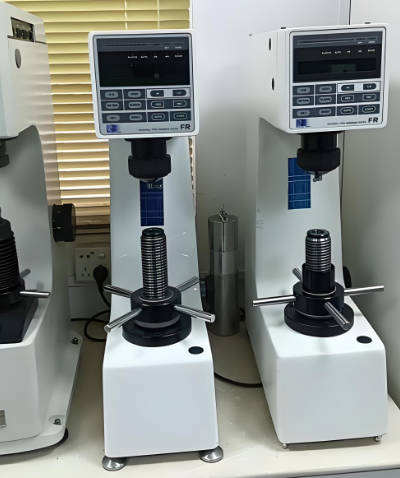
As an ISO/IEC 17025 accredited (CNAS) independent laboratory, we provide professional Rockwell hardness testing services for manufacturers, quality control laboratories, and engineering firms in Algeria. The Rockwell hardness test is one of the most widely used indentation hardness methods, valued for its speed, simplicity, and direct readout of hardness values. It measures the permanent depth of penetration of an indenter under a specific preload and total load. The test is applicable to a broad range of materials, including metals (steel, aluminum, copper, cast iron, titanium, alloys), hard plastics, and composites. Our laboratory operates multiple Rockwell hardness testers with various scales (A, B, C, D, E, F, G, H, K, N, T, etc.) to accommodate different material hardness ranges and component geometries. Results are reported with measurement uncertainty and are traceable to international reference blocks.
Types of Samples We Test
- Metal components (gears, shafts, bearings, fasteners, bolts, screws, nuts, washers)
- Automotive parts (engine blocks, cylinder heads, camshafts, connecting rods, brake discs, suspension components)
- Tooling and dies (cutting tools, molds, punches, dies, drill bits, milling cutters)
- Steel products (structural steel sections, reinforcing bars, plates, sheets, pipes, wire rods)
- Cast and forged components (cast iron parts, steel forgings, aluminum castings, brass fittings)
- Heat‑treated samples (hardened steel, quenched and tempered alloys, case‑hardened layers, nitrided surfaces)
- Plastic and polymer components (thermoplastics, thermosets, composites, industrial plastic parts)
- Welded joints and heat‑affected zones (for hardness mapping and weld quality assessment)
- Large or irregularly shaped components (tested on dedicated bench‑type or portable Rockwell units)
- Thin sheets, foils, and small precision parts (using specialized anvils and test fixtures)
Principle of the Rockwell Hardness Test
The Rockwell hardness test measures the difference in indentation depth between a preliminary minor load and a subsequent major load. The test sequence is fully automated on modern instruments, ensuring repeatability.
- Step 1 – Minor load application – A preliminary minor load (typically 10 kg or 3 kg depending on the scale) is applied to the indenter, causing it to penetrate the sample surface to a set depth. This step seats the indenter, eliminates surface irregularities, and establishes a reference zero position.
- Step 2 – Major load application – An additional major load is applied, increasing the total force on the indenter to a preset value (e.g., 60 kg, 100 kg, 150 kg). The indenter penetrates further into the material under the increased force. The load is held for a short dwell time (typically 2–5 seconds) to allow plastic deformation to stabilize.
- Step 3 – Major load removal – The major load is removed, while the minor load remains applied. The indenter recovers elastically but not plastically; the permanent depth increase (e) is measured.
- Step 4 – Hardness value calculation – The Rockwell hardness number is derived from the formula: HR = N – (e / s), where N is a scale‑dependent constant (e.g., 100 for B and C scales) and s is the unit of indentation depth (0.002 mm for standard scales). The result is displayed directly on the machine dial or digital readout.
Common Rockwell Scales and Their Applications
Different Rockwell scales use different combinations of indenter type and load magnitude to match the hardness range and material characteristics. The following scales are most frequently requested in our laboratory.
- Rockwell B scale (HRB) – Indenter: 1/16 inch (1.588 mm) diameter steel ball. Minor load: 10 kg. Major load: 100 kg. Total load: 110 kg. Application: softer metals (annealed steel, aluminum alloys, copper alloys, brass, bronze, soft cast iron). Typical range: HRB 20–100. For materials harder than HRB 100, the C scale is more appropriate.
- Rockwell C scale (HRC) – Indenter: diamond cone (120° apex angle, 0.2 mm tip radius). Minor load: 10 kg. Major load: 150 kg. Total load: 160 kg. Application: harder steels (quenched and tempered, tool steels, hardened alloy steels, bearing steels, cast iron, case‑hardened layers). Typical range: HRC 20–70. Values above 70 may cause diamond indenter damage; values below 20 lack resolution.
- Rockwell A scale (HRA) – Indenter: diamond cone. Minor load: 10 kg. Major load: 60 kg. Total load: 70 kg. Application: extremely hard materials (tungsten carbide, cemented carbides, thin hard coatings, surface‑hardened layers, ceramic materials). Typical range: HRA 60–85. Provides lower load to prevent cracking of brittle materials.
- Rockwell D scale (HRD) – Indenter: diamond cone. Minor load: 10 kg. Major load: 100 kg. Total load: 110 kg. Application: intermediate hardness between A and C (surface‑hardened steels, thin case depths, pearlitic malleable iron).
- Rockwell E scale (HRE) – Indenter: 1/8 inch (3.175 mm) steel ball. Minor load: 10 kg. Major load: 100 kg. Total load: 110 kg. Application: softer materials (cast iron, aluminum alloys, bearing metals, some plastics).
- Rockwell F scale (HRF) – Indenter: 1/16 inch steel ball. Minor load: 10 kg. Major load: 60 kg. Total load: 70 kg. Application: thin soft metal sheets (annealed copper, brass, aluminum foil).
- Rockwell G scale (HRG) – Indenter: 1/16 inch steel ball. Minor load: 10 kg. Major load: 150 kg. Total load: 160 kg. Application: sintered materials, bearing bronzes, beryllium copper, some malleable irons.
- Rockwell H scale (HRH) – Indenter: 1/8 inch steel ball. Minor load: 10 kg. Major load: 60 kg. Total load: 70 kg. Application: aluminum, zinc, lead, and very soft plastics.
- Rockwell K scale (HRK) – Indenter: 1/8 inch steel ball. Minor load: 10 kg. Major load: 150 kg. Total load: 160 kg. Application: bearing metals, soft cast irons, and other relatively soft materials.
- Superficial Rockwell scales (N and T series) – Indenters: diamond cone (for N scales: 15N, 30N, 45N) or 1/16 inch ball (for T scales: 15T, 30T, 45T). Minor load: 3 kg. Major loads: 15 kg, 30 kg, 45 kg. Application: thin sheet materials (foils, coatings, case‑hardened layers down to 0.1 mm thickness), small precision parts, and components where standard loads would cause excessive deformation or breakthrough.
Test Procedure and Sample Preparation
Proper sample preparation and test conditions are critical for obtaining accurate and repeatable Rockwell hardness results. The following steps are followed in our laboratory.
- Surface preparation – The test surface must be clean, dry, and free from oil, grease, scale, rust, or coatings that could influence the indentation. For metals, light grinding or polishing is performed to achieve a smooth surface with a finish of Ra ≤ 1.6 µm (for most scales). For plastics, the surface should be flat, smooth, and free from scratches or sink marks.
- Thickness requirement – The sample thickness must be at least ten times the depth of indentation to avoid anvil effects and ensure that the test measures bulk material properties, not support‑induced resistance. Minimum thickness guidelines: for HRC at 65 HRC, minimum thickness 0.6 mm; for HRB, minimum thickness 1.5 mm. For thinner materials, superficial Rockwell scales are used.
- Separation between indentations – To avoid work hardening interference, the center of each indentation must be spaced at least three times the indentation diameter from adjacent indentations and at least 2.5 times the diameter from the specimen edge.
- Sample mounting – Small or irregularly shaped specimens are mounted in resin or secured using custom fixtures to provide a stable, perpendicular test surface. The sample must rest firmly on the anvil without rocking or shifting during load application.
- Indenter verification – Diamond indenters are inspected under a microscope for chips, cracks, or wear. Steel ball indenters are examined for flattening or surface damage. Indenters are replaced according to a defined schedule or immediately upon damage detection.
- Machine calibration and verification – Daily verification is performed using certified Rockwell hardness reference blocks (traceable to national metrology institutes). At least two indentations are made on the reference block, and the average must fall within the certified tolerance (±1.0 HR for B and C scales). Annual full calibration is carried out by an accredited metrology service.
Interpretation of Rockwell Hardness Values
Rockwell hardness numbers are dimensionless but are directly related to material strength and wear resistance for many materials. The following relationships and considerations are commonly applied.
- For steel (HRC and HRB) – There is an approximate correlation with tensile strength: for quenched and tempered steels, tensile strength (MPa) ≈ 3.5 × HRC × 10, but this varies by composition and heat treatment. For soft steels, HRB 80–100 corresponds to tensile strengths of 400–700 MPa.
- For aluminum alloys – Rockwell B and E scales are used. Wrought aluminum alloys: HRB 20–80 (annealed to full hard). Cast aluminum alloys: HRE 40–80.
- For copper alloys – HRB and HRF scales. Annealed copper: HRB 10–20; hard drawn copper: HRB 40–60; brass: HRB 30–90.
- For plastics – Rockwell E, M, R, or L scales are used. A lower hardness number indicates greater indentation depth, i.e., softer material. Common ranges: hard thermoplastics (HRE 60–100), thermosets (HRE 100–120).
- Case depth assessment – For carburized or nitrided steels, a series of Rockwell indentations can be made from the surface inward (on a cross‑section). The depth at which the hardness drops to a specified value (e.g., 50 HRC) is reported as the effective case depth.
Common Errors and How to Avoid Them
Even with proper equipment, several factors can introduce errors in Rockwell hardness testing. Our technicians are trained to recognize and prevent these issues.
- Anvil effect (insufficient sample thickness) – If the sample is too thin, the indenter may “bottom out” against the anvil, producing an erroneously high hardness reading. Solution: use superficial scales or increase sample thickness.
- Curved surfaces – Testing on cylindrical surfaces (e.g., rods, pipes) requires correction factors or specialized anvils. For convex surfaces, the hardness reading is lower than the true value; for concave surfaces, higher. Tables of corrections are applied when conversion to flat‑surface equivalent is required.
- Surface roughness – A rough surface increases indentation depth, leading to lower hardness readings. Grinding or polishing to a smooth finish (Ra < 1.6 µm) eliminates this error.
- Vibration or sample movement – Any movement during load application invalidates the test. Ensure the sample is firmly seated and the machine is on a vibration‑isolated bench.
- Scale selection error – Using too large a load on a thin or soft sample may cause penetration through the sample, while using a ball indenter on a very hard material may flatten the ball. Always verify the scale suitability before testing.
- Operator bias – Manual machines (still used for some scales) require consistent load application and release timing. Automated machines eliminate most operator variables.
- Indenter contamination – Dirt or residue on the indenter tip changes the indentation geometry. Clean the indenter with soft tissue after each test.
Comparison with Other Hardness Test Methods
The Rockwell test is often selected over Brinell, Vickers, or Leeb tests for specific reasons. Our laboratory advises clients on the most suitable method for their application.
- Rockwell vs. Brinell – Rockwell is faster and leaves a much smaller indentation, making it suitable for finished parts. Brinell uses a larger ball (10 mm) and higher loads, providing an average hardness over a larger area – better for inhomogeneous materials (castings, coarse grain structures).
- Rockwell vs. Vickers – Vickers is more versatile (one scale for all materials) and allows very low loads (microhardness), but requires optical measurement of the indentation diagonal, which is slower than Rockwell’s direct‑readout depth measurement. Rockwell is preferred for routine production testing.
- Rockwell vs. Leeb (rebound) – Leeb hardness test is portable and suitable for large, heavy components that cannot be moved to a bench tester. However, Leeb is more sensitive to surface condition and operator technique. Rockwell offers higher accuracy for lab‑based quality control.
Reporting and Deliverables
Each Rockwell hardness test report includes the following information:
- Sample identification (material designation, batch number, component description, heat treatment state if known)
- Rockwell scale used (e.g., HRC, HRB, HRA, 15N) and indenter type
- Test conditions: minor load, major load, dwell time, number of indentations
- Individual hardness readings (typically 3–5 indentations) and the average value
- Statistical data: range (highest – lowest) and standard deviation when multiple indentations are performed
- Reference block verification result (certified value and measured average, within tolerance)
- Any corrections applied (e.g., curvature correction for cylindrical samples)
- Statement of measurement uncertainty (expanded uncertainty, k=2, expressed in HR units)
- Photographs (on request) showing indentation locations and any surface preparation
- Comparison with client‑supplied hardness specification (if provided) – conclusion of “pass” or “fail” based on the acceptance range
No statement of compliance with any external standard or regulation is made unless the client has provided specific acceptance criteria in writing. Raw data, calibration records, and reference block certificates are archived for a minimum of 10 years and are available upon request.
Typical Hardness Ranges for Common Materials (For Reference Only)
The following table provides approximate Rockwell hardness ranges for common materials. Actual values depend on alloy composition, heat treatment, and processing history.
- Low‑carbon steel (annealed): HRB 55–75
- Medium‑carbon steel (normalized): HRB 80–95
- High‑carbon steel (annealed): HRB 85–100
- Spring steel (hardened & tempered): HRC 42–48
- Tool steel (hardened): HRC 60–65
- Stainless steel 304 (annealed): HRB 70–88
- Stainless steel 316 (annealed): HRB 75–90
- Stainless steel 440C (hardened): HRC 58–60
- Cast iron (gray, as‑cast): HRB 65–95
- Cast iron (ductile, as‑cast): HRB 90–105 (or HRC 20–30)
- Aluminum 6061 (annealed): HRB 30–35
- Aluminum 6061 (T6): HRB 45–55
- Aluminum 7075 (T6): HRB 80–85
- Brass (cartridge, annealed): HRB 10–20
- Brass (half‑hard): HRB 40–60
- Copper (annealed): HRB 10–20
- Copper (hard drawn): HRB 40–50
- Titanium Grade 5 (Ti‑6Al‑4V, annealed): HRC 32–38
- Hardened bearing steel (52100, through hardened): HRC 60–64
- Case‑hardened steel (carburized depth 0.5–1.5 mm): surface HRC 58–62, core HRB 85–95
- Polycarbonate (unfilled): HRE 85–95
- Nylon 6/6 (dry as‑molded): HRE 100–110
- Acrylic (PMMA): HRM 95–105
Why Choose ZKGX?
- State-of-the-art analytical equipment
- Highly qualified scientific team
- Fast turnaround time
- Competitive pricing